
Blog
Why is the sheet mask MOQ 25,000 units? The line explains it
Buyers sample sheet masks more than almost any other category and order them less. The reason is the machine, not the manufacturer's mood.
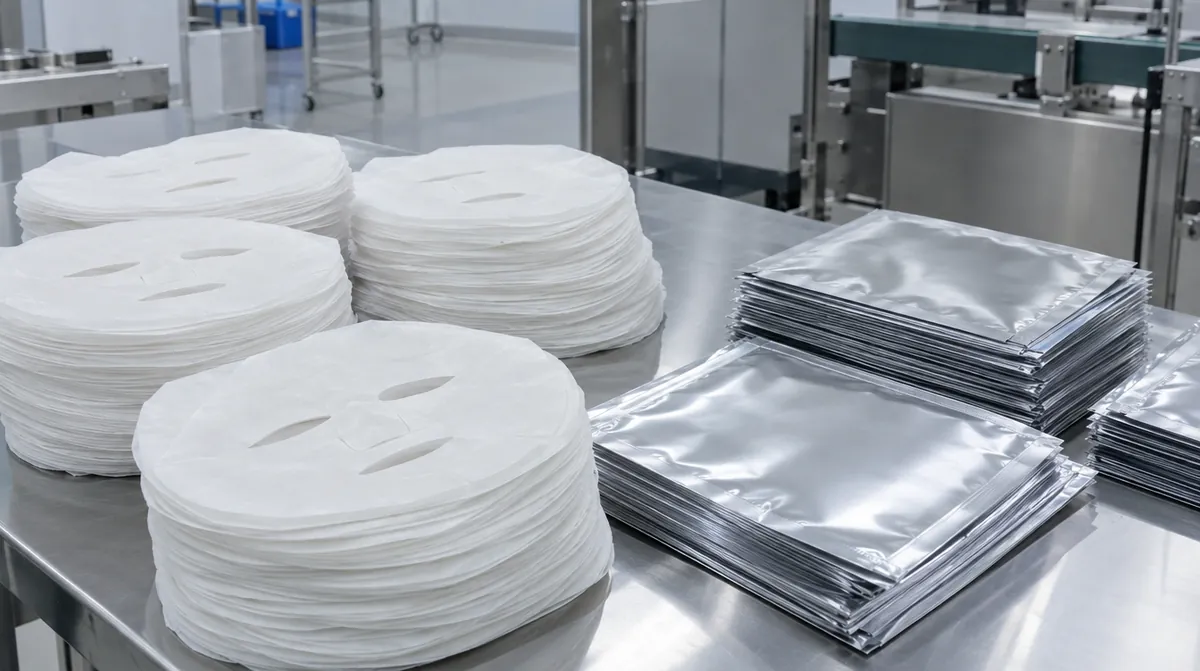 Illustrative image
How is a sheet mask made?
A sheet mask is three things made separately and married on one line: the sheet, the essence and the sachet. Each has its own minimum, and the highest one wins.
Read moreShow less
| Step | What happens | What sets the minimum |
|---|---|---|
| 1. Sheet material | Nonwoven (cotton or lyocell), cupra or bio-cellulose arrives in rolls or pre-cut sheets | Material is bought by the roll; one roll makes tens of thousands of sheets |
| 2. Die-cutting | Sheets are cut to the face shape, with eye, nose and mouth openings | The die is set up once per shape; changeovers cost line time |
| 3. Folding | A folding machine folds each sheet into the sachet format, often around a mesh or film carrier | Folding patterns are tuned per material and rarely changed mid-run |
| 4. Essence batch | The essence is made in a mixing tank, tested and held | A tank batch is sized for the line; small batches waste capacity |
| 5. Dosing | The folded sheet goes into the sachet and the essence is dosed on top, usually 20 to 30 ml | Dosing heads are calibrated per essence viscosity |
| 6. Sealing | The sachet is heat-sealed on three or four sides, date-coded and checked for leaks | Sachet film is printed in bulk by a film printer, not the mask line |
| 7. Packing | Sachets go into unit boxes or shrink packs, then cartons | Standard |
The sheet decides how the mask feels. Nonwoven cotton is the lowest cost and holds essence well. Lyocell and cupra are thinner and sit closer to the skin. Bio-cellulose is grown rather than woven, holds the most essence and costs the most; it is also the slowest to cut and fold.
Why does the line need 25,000 units?
Three of the seven steps are bulk-only, and they are the ones a brand sees on the shelf.
Read moreShow less
- Printed sachet film. Your design is printed on a roll of laminated film by a packaging printer. The printer's minimum run is set by plate-making and the length of film needed to get the press to colour. The roll then has to be used up; leftover film with your artwork is waste for everyone else.
- Sheet rolls and dies. The sheet material is bought by the roll and cut on a die made for the mask shape. A partner line will not stop a 100,000-unit run to set up a die for 2,000.
- Essence batches. Mask essence is made in tank sizes that match the line's dosing speed. A small batch costs almost as much labour and testing as a full one and ties up the tank.
On our side, the rule is written down and does not move: sheet masks 25,000, other masks and patches 50,000, hydrogel eye patches 300,000, and SKUs cannot be combined to reach the number. If you want 5 mask variants, that is 5 × 25,000.
Why is hydrogel 300,000?
Hydrogel eye patches are cast, not cut. The gel is poured onto a carrier film, set, then punched into the eye shape and packed into a jar or tray. The casting line runs continuously, and a product changeover means draining and cleaning the gel system. That is why the partner lines we work with set the minimum at 300,000 units, and why there is no small-batch route for hydrogel.
What do buyers do instead?
In our sample log, masks and packs are 7% of sample requests, and most of those projects never reach an order. The brands that do launch a mask product usually take one of these routes.
Read moreShow less
| Route | Minimum | How it works |
|---|---|---|
| Wash-off pack in a jar | 5,000 units | Clay, enzyme or gel pack filled on a standard cream line (OEM/ODM route) |
| Sleeping pack in a jar or tube | 5,000 units | A rich cream or gel-cream texture; same line as moisturizers |
| Toner pad in a jar | Quoted per project | Pre-soaked pads in a jar; easier than sachets, still a dedicated line |
| Sheet mask, one hero SKU | 25,000 units | One shape, one essence, one sachet design; add SKUs later |
| Skincare first, mask later | 300 to 5,000 units | Launch a toner, essence, ampoule or cream, then add a mask at the second order |
The first two routes use the same partner lines as moisturizers, so the lead time is the standard 2 to 3 months and the development sample is the standard USD 150, credited against the order.
"At almost every trade show someone asks us for 1,000 sheet masks with their logo. We explain the sachet film and the die, and most of them switch to a sleeping pack in a jar. The ones who really want a sheet mask come back when they can place 25,000." — Minjae Lee, Head of Overseas Sales
What does a sheet mask project need from you?
If you can place 25,000 units, this is what we ask for before quoting.
- Sheet type: nonwoven cotton, lyocell, cupra or bio-cellulose. This is the largest cost driver after volume.
- Essence concept: hydrating, soothing, brightening or firming, and any hero ingredient. The essence is developed like any other formula, with a sample in about 2 weeks.
- Sachet size and artwork: the sachet is your main packaging, so the design fee of USD 200 applies if we design it.
- Target market: the EU, the US and the Gulf each add label and registration requirements; see the export checklist.
- Unit box or not: sachets can ship in shrink-wrapped bundles or in printed unit boxes. The box adds cost and a second printing minimum.
Lead time is the same 2 to 3 months as other categories once the essence sample is approved.
Can I order 5,000 sheet masks if I pay a higher unit price?
No. The 25,000 minimum is set by the sachet film, the die and the essence batch, not by price. A higher unit price does not shorten a film roll.
Can I combine 5 mask variants of 5,000 each to reach 25,000?
No. Each variant has its own sachet artwork and essence, so each one needs its own 25,000. Combining SKUs is not possible for masks, hydrogel, patches or sunscreen.
Which sheet material is cheapest?
Nonwoven cotton. Lyocell and cupra cost more and feel thinner; bio-cellulose is the most expensive and holds the most essence. We quote the same essence on two sheet types if you want to compare.
What is the alternative for a small brand that wants a mask?
A wash-off or sleeping pack in a jar from 5,000 units on the OEM/ODM route, or a skincare line from 300 units with the ready formulas, adding a mask later.
How long does a sheet mask order take?
About 2 weeks for the essence sample, then 2 to 3 months for production including sachet film printing. Registration for your market runs in parallel and is quoted at cost.
If your plan is a sheet mask at 25,000 units or a pack in a jar at 5,000, tell us the sheet type and the essence concept and we will quote within 24 hours. Ask for a mask quote
Tell us what you want to make.
Send the product, market and quantity. You get a written quote and a formula route within 24 hours.