
Blog
What do stability, challenge and compatibility tests check, and when do they run?
A formula that looks perfect in the sample jar can separate, discolour or lose its pump in the final container. Three tests catch that before the production batch is filled.
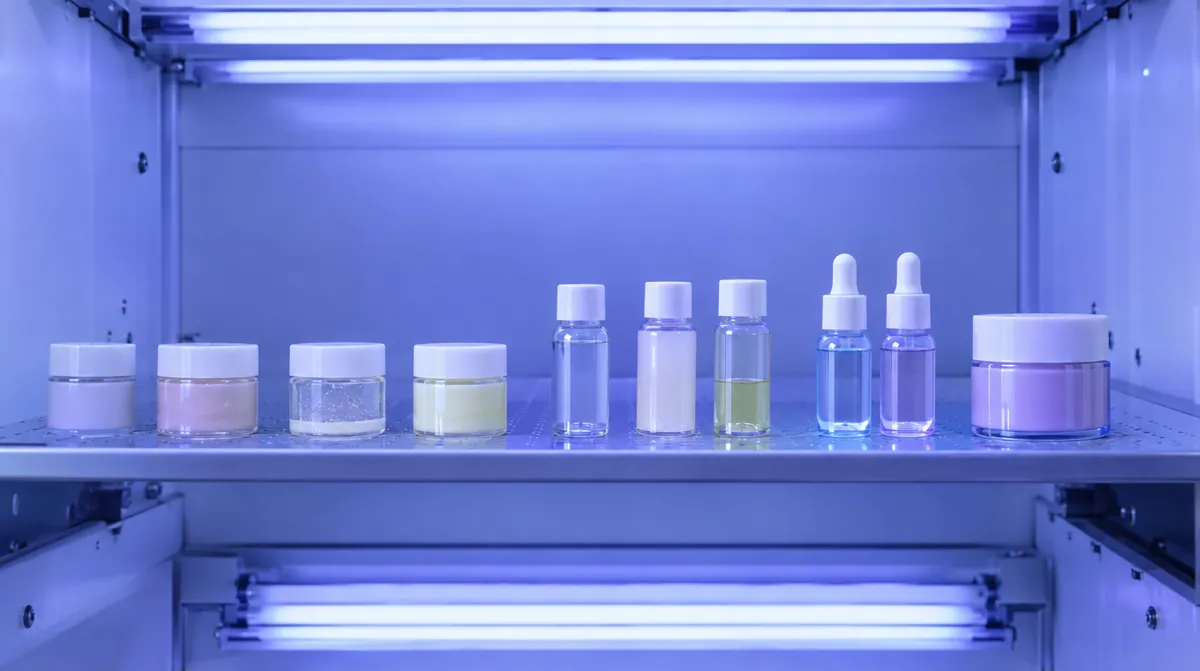 Illustrative image
What does a stability test check?
A stability test asks one question: will the product on the shelf in month 18 be the product you approved in week 2? The bulk formula is stored under several conditions and inspected at set intervals.
Read moreShow less
| Condition | What it simulates | What is checked |
|---|---|---|
| Room temperature | Normal storage | Appearance, colour, odour, pH, viscosity |
| Elevated temperature | Warehouses, shipping containers, hot climates | Separation, thinning, colour and odour change, active degradation |
| Low temperature and freeze-thaw cycles | Winter transport, cold storage | Crystallisation, emulsion breaking, texture change after thawing |
| Light exposure | Shop windows, bathroom shelves | Colour fading, odour change |
Elevated-temperature storage is used as an accelerated proxy: a formula that holds for a few months in heat is expected to hold for its labelled shelf life at room temperature. Real-time storage continues in parallel and is what finally supports the date of minimum durability or the period-after-opening symbol on an EU label.
What does a challenge test check?
A preservative challenge test deliberately contaminates the formula with standard bacteria, yeast and mould and measures how fast the preservative system kills them over 28 days. It is the evidence that a water-based cream, toner or essence will not grow microbes once the consumer opens it. The EU safety assessor expects this test in the Product Information File for most water-containing products, and the same data supports safety substantiation under MoCRA in the US.
A challenge test is run on the final formula. If the formula changes after the test, for example a lower preservative level to meet a "gentle" brief, the test is run again.
What does a compatibility test (CT) check?
A compatibility test puts the formula into the actual container, cap, pump or dropper and stores the filled unit under the same conditions as the stability test. It checks the pair, not the formula alone.
Read moreShow less
- Container: deformation, cracking, discolouration, panelling (a bottle sucking inward), weight loss through the walls.
- Closure and pump: leakage, pump or dropper failure, cap stress-cracking, thread damage.
- Formula: colour or odour change caused by the packaging material, pH drift, active loss, migration of ink or glue.
- Decoration: label adhesion, print rubbing off, silk-screen flaking after contact with the product.
A CT is what tells you that an oil-rich essence will not soften a particular pump gasket, or that a retinol ampoule needs an amber glass rather than a clear PET bottle.
When do the tests run in an ODM project?
| Stage | Test | Why here |
|---|---|---|
| Sample development (about 2 weeks) | Quick bench checks: pH, viscosity, short heat test | Rule out obvious problems before you see the sample |
| Sample approved, container selected | Stability on the final formula, challenge test, CT in the chosen container | The formula and the packaging are now fixed |
| Before contract and 50% deposit | Results reviewed; packaging or formula adjusted if anything fails | Changing a pump before the order is cheap; after filling it is not |
| Production (2 to 3 months) | Batch QC: sensory, physical and microbiological checks on the bulk, then fill volume and appearance on the line | Confirms the batch matches the tested formula |
| After shipment | Real-time stability continues | Supports the shelf life written on the label |
The accelerated results arrive first and are used to make decisions. Real-time storage runs for the length of the shelf life and is kept on file. The testing laboratory's fees are quoted at cost and are not part of the unit price.
Why do bring-your-own containers always need a CT?
When you take a formula on the private label route in the standard container, the pair has already been tested. When you ship your own bottles, jars or pumps to the partner line, the pair is new, and so are the risks: a different plastic, a different gasket, a pump from a supplier nobody on the project has used before. That is why our bring-your-own-container route always runs in this order: receive your containers, run the CT, confirm compatibility, fill, finish in your packaging. You pay for the test, and you own the result.
Read moreShow less
"The expensive CT failures we have seen were pumps. A buyer sends a beautiful pump bottle, the formula is fine, and three weeks into the heat test the pump stops drawing. Finding that before 5,000 units are filled is the whole point of the test." — Minjae Lee, Head of Overseas Sales
What do you receive?
For each product we hand over a stability summary, the challenge test report and the CT report from the laboratory or partner line. These go into the EU Product Information File alongside the certificate of analysis, the MSDS and the INCI list, and they are part of the data package we supply for the US and the Gulf. See the full document list on the regulatory page.
How long does a stability test take?
The accelerated part takes weeks to a few months depending on the formula and the shelf life you want to claim. Real-time storage continues for the full shelf life. We plan the accelerated part so it fits inside the 2 to 3 month production window where possible.
Do the ready private label formulas need new tests?
Not in the standard container: the formula and container pair has been tested. A new container, a new label material in contact with the product, or a formula adjustment triggers a new CT or stability run.
Can I skip the CT if my container supplier says it is compatible?
We do not fill a bring-your-own container without a CT. The supplier's statement covers their material in general, not your formula in their container.
Who pays for the tests?
You do, at the laboratory's cost, quoted separately from the unit price. The results are yours and go into your registration files.
What if a test fails?
We change the packaging component or adjust the formula and retest. This is why the tests run before the contract: a failed pump is a purchasing change, not a scrapped batch.
Sources
Tell us whether you want the standard container or your own, and we will build the test plan into the quote. Start with a sample
Tell us what you want to make.
Send the product, market and quantity. You get a written quote and a formula route within 24 hours.