
Guide
How to start a skincare brand with a Korean manufacturer, step by step
The order of operations that gets a first brand from an idea to a shipped order in about 3 to 4 months, with the costs and decisions at each step.
What do you need before you contact a manufacturer?
Three decisions, written down. They are the whole brief, and the quality of the quote you get depends on them.
Read moreShow less
| Decision | Why it matters | Example |
|---|---|---|
| Product and claim | Decides the formula route and the minimum | "A hydrating toner for dry, sensitive skin" |
| First market | Decides the registration, the label language and the duty | "Germany, then the rest of the EU" |
| First-order quantity and budget | Decides which route is even possible | "500 units per SKU, under USD 10,000 all in" |
If you have a reference product, name it. If you have a target retail price, say it; a manufacturer can work backwards from a shelf price to a unit cost.
Behind the three decisions sits one sentence a stranger would understand: who the brand is for and what it does for them. "Korean skincare" is a category, not a positioning. "A simple barrier-repair routine for people whose skin reacts to everything" is a positioning, and it decides the formulas, the claims, the packaging and the channel. If you cannot write that sentence yet, research first and order later.
The 10 steps
Read moreShow less
- 01
Define the product and the market
Write one paragraph: who the customer is, what the product does, what it should feel like, and where it will be sold first. Decide the number of SKUs. A 1-SKU launch is cheaper and faster; a 3-step routine (toner, serum, cream) tells a clearer story. Our sample log shows what other first-time brands in your region sampled.
- 02
Set a budget that includes everything
Add up product, samples, design, registration, freight and duties. For a 300-unit toner at $7.95 the product line is $2,385; for 1,000 units at $6.32 it is $6,320. Add USD 150 for samples (credited back), USD 200 if we design the package, and separate lines for registration and freight. Decide what you can spend before deciding what to make.
- 03
Choose the route
Private label from 300 units if a ready formula fits your brief. Your own formula from 1,000 units if you need a change in actives, scent or texture, or if the formula is the brand. Cleansers, body and hair care and makeup start at 5,000 units. The OEM vs ODM vs private label guide has a decision list.
- 04
Send the brief and get an itemized quote
Through the quote form: product, market, quantity, target price, reference product if any. We reply within 24 hours, match the brief to a formula route and a partner line, and send an itemized quote with unit price, tiers, what is included, Incoterm, payment terms and validity.
- 05
Order samples and test them
Pay the USD 150 sample fee. Development samples arrive in about 2 weeks, up to 10 units per round. Test them on real skin for at least a week, in the climate where they will be sold if you can. Give written feedback. A second round adds about 2 weeks. Lock the formula before you touch packaging.
- 06
Choose packaging and finish the design
Standard containers with your label are the fast path. Direct printing on the container needs 1,000 units or more; custom-printed containers need 5,000. If you bring your own containers, we run a compatibility (CT) test between the formula and the container before filling. Artwork for the label and carton comes from your designer or from our design team at USD 200.
- 07
Start registration in parallel, not after
For the EU: appoint a Responsible Person, have a safety assessor issue the CPSR, and let the RP notify on CPNP before sale. For the US: the partner facility registers and the product is listed under MoCRA. For the Gulf: your importer registers with the national authority. We supply the formula data, INCI list, COA and label review; the cost is quoted at cost. Start this when the formula is locked, so it runs alongside production.
- 08
Sign and pay the 50% deposit
Production is scheduled on the deposit. Orders of 300 to 999 units are confirmed when a production batch is scheduled, so tell us your launch date early. After the deposit we send 2 to 3 final samples for approval. Have five things in writing at this point: the quantity per SKU, the lead time, the sample and golden-sample approval steps, the payment stages, and the documents that ship with the goods.
- 09
Production and the golden sample
Production takes 2 to 3 months including containers. Before the balance is due you approve the golden sample: a finished unit in the final packaging that becomes the reference for the whole lot. Every batch is checked at six stages from raw material to shipment approval.
- 10
Pay the balance, ship and launch
The remaining 50% is paid before shipment. We prepare the export documents (MSDS, INCI list, COA, certificate of free sale, invoice, packing list, bill of lading, certificate of origin) and hand over on the agreed Incoterm: FOB Korea for private label, EXW for OEM and ODM. Your importer clears customs and pays duty and VAT. Launch when the registration in your market is complete.
How long does each stage take?
| Stage | Time | What you are waiting for |
|---|---|---|
| Brief to quote | Within 24 hours | Our reply |
| Samples, first round | About 2 weeks | Partner lab |
| Samples, second round (if needed) | About 2 weeks | Partner lab |
| Packaging and artwork approval | 1 to 3 weeks | Your decisions, your designer |
| Production, containers included | 2 to 3 months | Partner line |
| Registration (EU CPNP, US MoCRA listing) | Runs in parallel | Your RP or importer |
| Freight | Depends on destination and mode | Carrier |
Add the rows that apply and you land at about 3 to 4 months from brief to departure for a private label order with one sample round. Custom containers, several sample rounds or a late artwork change each add weeks.
What goes wrong most often?
Read moreShow less
"In our experience, the projects that slip are not the ones with difficult formulas. They are the ones where the brand changed the brief after the first samples, or started the EU paperwork after production was finished. Both cost a month each, and both are avoidable." — Minjae Lee, Head of Overseas Sales
- Changing the brief after samples. Each new round adds about 2 weeks. Decide what you are testing before the first round.
- Choosing packaging before the formula is locked. A different viscosity can need a different pump.
- Registration started late. EU notification cannot be done without the final formula and label, and the product cannot be sold until it is done.
- Underestimating freight and duties. Private label prices are FOB Korea. Ask your forwarder for a quote at the same time as you ask us for one.
- Leaving too little time for artwork. Design and proofing are the usual delay, not the partner line or the formula. Allow more time than you think.
- Not leaving space for mandatory text. Ingredient list, net content, batch code, durability date, the responsible company's details and the right language all have to fit on a small label. Lay them out before the brand graphics.
- Treating claims as marketing copy. In most markets what the label says is a legal statement. Check claims before you print, not after.
- Forgetting the label rules of the market. Ingredient list, RP or importer address, batch number, durability, warnings, language. We review labels against the rules you tell us; your importer gives final approval.
What happens after the first order?
A first run is a data exercise. Track the repurchase rate per SKU, not only units sold: the product people buy twice is your real lead product, and it is often not the one you expected. Most first ranges find that one or two SKUs do most of the selling.
Read moreShow less
Use that to plan the second order:
- Reorder what repeats, at the next price tier if the sell-through supports it. The toner drops from $7.95 at 300 units to $7.02 at 500 and $6.32 at 1,000.
- Drop or replace what does not. A slow SKU costs the same artwork, registration and stock work as a fast one.
- Build a signature product around the one that repeats, as your own formula from 1,000 units: a different active, scent or texture that a competitor cannot order from the same list.
What do you get at the end?
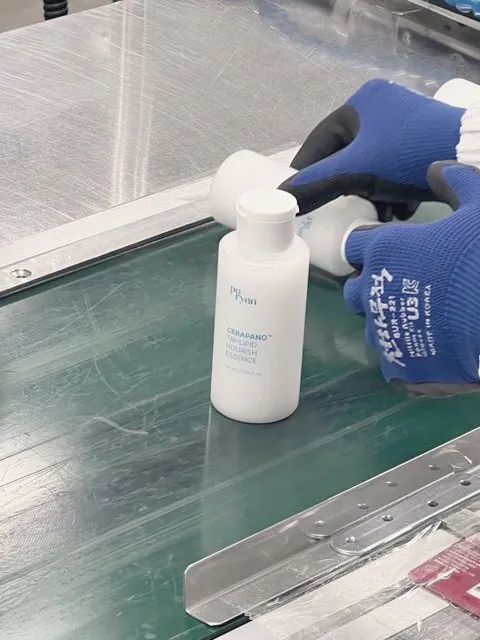
A shipped order of finished, labelled, cartoned products with the export documents, a golden sample on file, and the formula data your market's safety file needs. For the EU, that means the PIF and CPSR data; we have done this for our own brand PURYNN, which was notified on CPNP on 2026-07-20 with a Responsible Person in Poland.
How much money do I need to start a skincare brand with a Korean manufacturer?
A 1-SKU private label launch of 300 units is about $2,400 in product plus USD 150 for samples and freight. A 1,000-unit, 2-SKU launch is about $13,000 in product. Registration and duties come on top and depend on your market.
How many products should I launch with?
Usually 1 to 4. Four ready formulas (toner, essence, ampoule, cream) make a routine a customer can follow and a set that photographs well, and at 300 units each that is 1,200 units. Beyond that, each SKU adds artwork, registration, stock and forecasting work for less return.
Do I need my own formula to start?
No. Many brands launch on ready formulas and develop their own once they know what customers repurchase. Positioning and channel do more early work than formula exclusivity.
Can I start with one product?
Yes. The 300-unit minimum is per SKU, and you can order 1, 2, 3 or all 4 of the ready formulas.
Do I need a company to order?
You need an entity to import and to hold the registration in your market: a company, or an importer or distributor acting for you. In the EU the Responsible Person must be established in the EU.
How long before I can sell?
About 3 to 4 months to a shipped order, plus transit and the registration in your market if it is not finished when the goods arrive.
Can you design my brand?
We design labels, cartons and container artwork for USD 200. Brand strategy, naming and logo design are yours or your agency's.
Do I have to visit Korea?
No. All of our client projects run by email, WhatsApp and video calls; samples travel by courier. We also meet buyers at Cosmoprof Asia in Hong Kong (11 to 13 November 2026).
Ready to start? Order samples of the 4 ready formulas, or send a brief for your own product.
Tell us what you want to make.
Send the product, market and quantity. You get a written quote and a formula route within 24 hours.