
Blog
How to write a cosmetic product brief: 6 parts and a one-page template
The brief is the one part of development you fully control. A clear one gets a usable first sample; a vague one buys an extra round of about 2 weeks.
 Illustrative image
Why does the brief matter so much?
Development runs in loops: you brief, the lab makes a sample, you react, the lab adjusts. Each loop takes about 2 weeks. A vague brief does not save time at the start; it adds a round or two at the end, and that is where launch dates slip.
You do not need to write a technical specification. If you could, you would be ordering OEM against your own formula. The aim is to remove doubt about what "good" looks like, so the lab builds the right sample the first time.
What are the six parts?
Read moreShow less
1. Market and customer
Country or region, sales channel, and who buys it. The same "hydrating cream" is a different product for a Gulf pharmacy, a Polish drugstore and a Southeast Asian online shop. Name the market first, because it decides which ingredients are allowed, which claims you can make and what the label must carry. "Global" means the formula has to satisfy the strictest market on your list.
2. Product type and texture
Name the category (toner, essence, serum, ampoule, lotion, cream, cleanser) and then describe how it should feel. Most briefs under-write this part. Useful words: watery, gel, milky, rich; fast-absorbing or cushiony; matte or dewy finish; sticky or not; scented or unscented; clear or opaque. Say what you do not want, too. "Not greasy" is a real instruction.
3. Key ingredients and claims
List the ingredients the product must contain, the ones it must avoid, and the claims you plan to put on the label. Separate the ingredients that are there for performance from the ones that are there for the story. Both are legitimate, but the lab handles them differently. If a claim carries your marketing, such as soothing or long-lasting hydration, say so: in the EU every claim needs evidence that meets the common criteria in Regulation (EU) No 655/2013.
4. Packaging
Container type, fill size, material, and whether you will use a standard container or your own. This affects the formula, not just the look: a pump, a dropper and a wide jar need different viscosity and preservation. If you already have a container supplier, say so, because we will run a compatibility (CT) test with your container.
5. Quantity and deadline
First order quantity, expected reorders, and the real deadline with the reason behind it. "Trade show on 11 November" is something we can plan around. "As soon as possible" hides whether you can afford one more sample round. The quantity also decides the route: 300 units for our ready formulas, 1,000 for your own skincare formula, 5,000 for cleansers, body care, hair care and makeup.
6. Reference products
Name two or three products on sale today and say what you like and dislike about each. This part removes more doubt than all the others together, because a texture target becomes concrete the moment the lab can touch it. If you can, send the products themselves to our office.
The one-page template
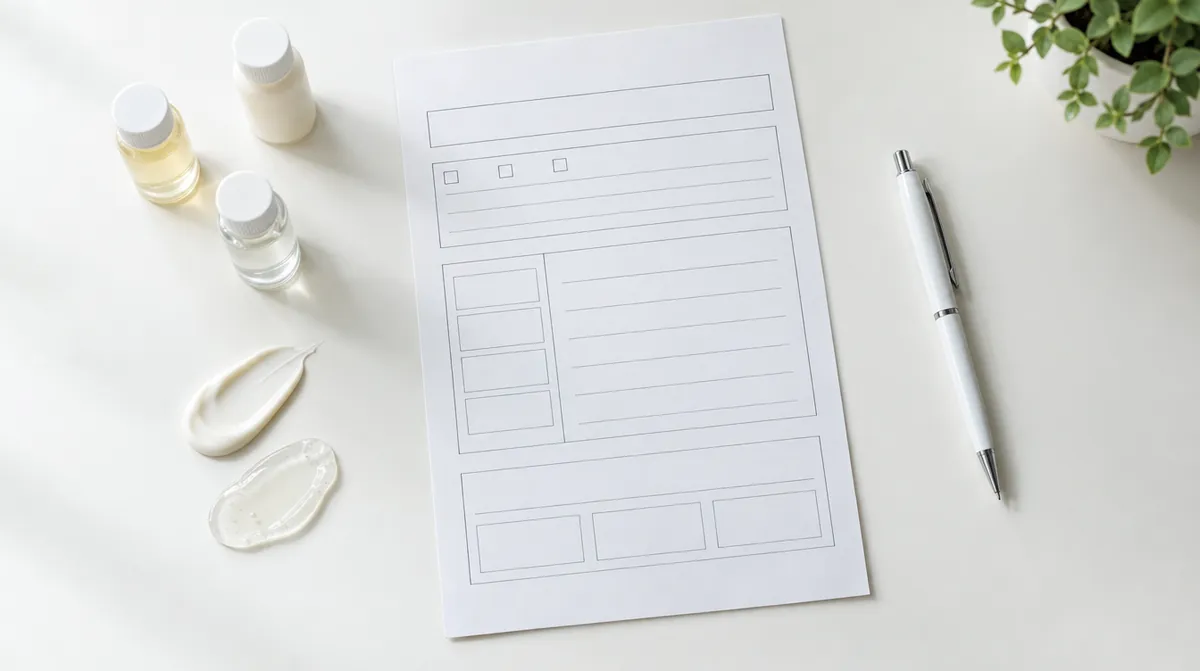
Copy this table into an email or a document and fill in every row. Blank rows are fine; they tell us where to ask.
Read moreShow less
| Section | What to write |
|---|---|
| Market | Country or region, channel, target customer |
| Product | Category, fill size, number of SKUs |
| Texture | How it should feel; what it must not feel like |
| Must contain | Key ingredients, and why each one is there |
| Must avoid | Ingredients, allergens, fragrance, origin restrictions |
| Claims | What the label and marketing will say |
| Packaging | Container type, material, standard or your own |
| Quantity | First order, expected reorder |
| Deadline | Date, and what drives it |
| References | 2 to 3 products on sale, with likes and dislikes |
| Budget | Target price per unit and Incoterm |
What are the common mistakes?
- Chemistry instead of outcomes. Fixing a percentage without knowing the rest of the formula usually constrains it in ways you did not intend. Describe the result; let the lab build the system.
- An open market. "Everywhere" forces the strictest rules on the whole formula.
- Only likes. Dislikes tell the lab more.
- A hidden deadline. The lab plans rounds differently when it knows the real date.
- Too many hero ingredients. A formula with eight headline actives usually has eight at token levels.
What happens after you send it?
- We reply within 24 hours and tell you which route fits: a ready formula, an adjusted formula or a new development.
- You receive an itemized quote.
- The lab makes the first sample in about 2 weeks. The development fee is USD 150, credited in full against your production order, with up to 10 units per round.
- You test and send written feedback; each further round takes about 2 weeks.
If you would rather skip development, our private label route uses 4 ready formulas from 300 units, and your brief becomes a choice of formula, label and carton.
"In our experience, a reference product in the parcel does more than a page of adjectives. When a buyer sends the cream they love and writes 'this, but less sticky', the first sample is usually close." — Minjae Lee, Head of Overseas Sales
What should a cosmetic product brief include?
Market and customer, product type and texture, key ingredients and claims, packaging, quantity and deadline, and two or three reference products with what you like and dislike about each.
Do I need to specify ingredient percentages?
Usually not. Describe the result and any ingredient that must be present or absent. Exact percentages belong in an OEM specification for your own formula, not an ODM brief.
How many sample rounds are normal?
One for a ready formula, one or two for an adjusted formula, two or three for a new development. Each round takes about 2 weeks.
Can I send a competitor product as a reference?
Yes, and it is one of the most useful things you can do. It gives the lab a texture target; it does not mean the formula will be copied.
What if I do not know which texture I want?
Pick products you already like, say what you would change, and the lab works from there.
Sources
Fill in the template, attach photos of your reference products, and send it to us. You will have a route and a sample plan within 24 hours. Get a quote
Tell us what you want to make.
Send the product, market and quantity. You get a written quote and a formula route within 24 hours.