
Blog
What does an Amazon seller need from a Korean manufacturer before the first listing?
The listing, the barcode and the FBA prep are yours. The formula data, the certificates and the carton specs are ours. Here is the split, item by item, with first-order budgets and a unit-economics template.
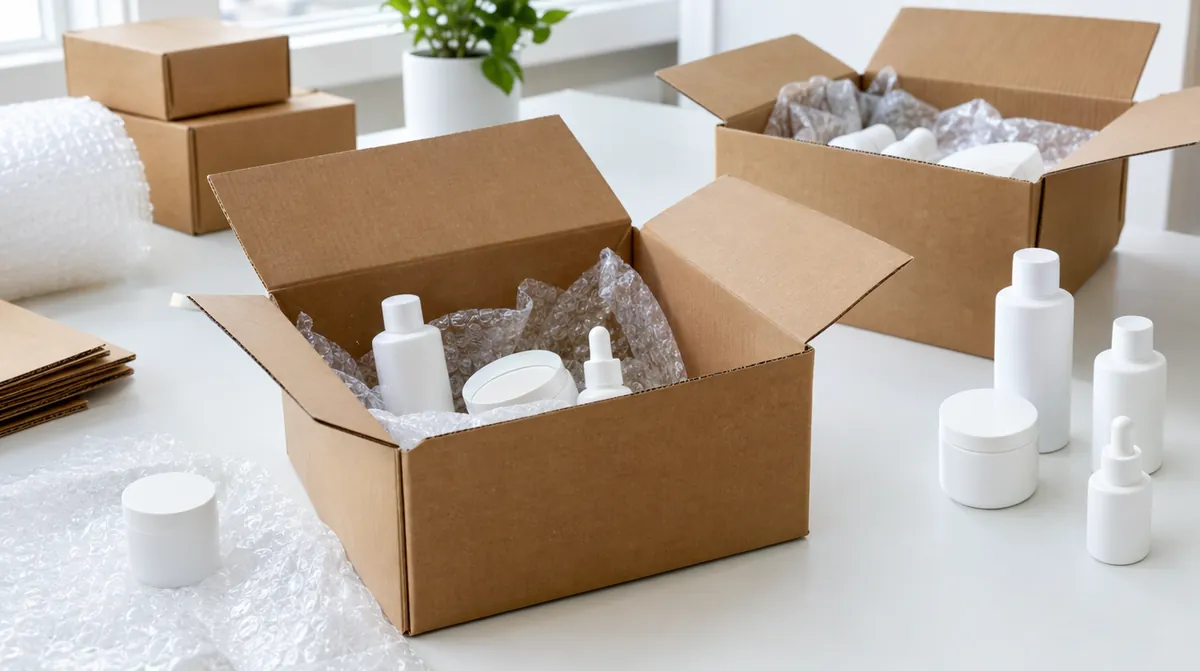 Illustrative image
What is the manufacturer's side and what is yours?
| Item | Who | Notes |
|---|---|---|
| Formula, filling, QC | Manufacturer | Standard container or your own after a compatibility test |
| MoCRA facility registration status and product listing data | Manufacturer supplies; seller's US responsible person lists | Product name, category, ingredients, facility details |
| Certificate of analysis (COA) per batch | Manufacturer | Appearance, pH, viscosity, microbiological results |
| Full ingredient list (INCI) and MSDS | Manufacturer | Needed for the listing's ingredient field and for customs |
| Label artwork and compliance review | Manufacturer reviews; seller approves | US label rules: identity, net quantity, ingredients, name and place of business, warnings |
| GS1 barcode (UPC/EAN) | Seller | Registered to your company, printed on the label or carton we produce |
| Amazon listing, brand registry, category approval | Seller | Amazon's requirements change; check Seller Central for the current list |
| FBA prep: polybags, suffocation warnings, FNSKU labels, case packs | Seller or your prep centre | We print the FNSKU on the carton or unit if you send the file before production |
| Import clearance, duties, freight to the FBA warehouse | Seller's broker and forwarder | We ship EXW or FOB Korea with the export documents |
Read moreShow less
The split follows the law, not preference. Under MoCRA the facility that makes the product registers with the FDA and the brand named on the label is the responsible person for product listing, adverse event records and safety substantiation. Amazon will ask you, not us, for whatever documents its category rules require, so keep the COA, INCI list and MSDS on file from day one.
What data do we provide for the MoCRA listing?
The product listing is yours to file, but every field in it comes from the manufacturer. For each SKU we provide:
Read moreShow less
- Product name as it will appear on the label, and the cosmetic category
- The full ingredient list in INCI order, matching the label
- The partner line's facility registration status, so your listing references a registered facility
- Label images and the responsible person details you tell us to print
- A certificate of analysis for the batch and the stability and challenge-test summaries that support safety substantiation
For sunscreen, SPF lip balms or anything with a drug claim, the product is an OTC drug and the minimum is 10,000 units; see why US sunscreen needs 10,000 units.
The document pack, and when you get each piece
Amazon sellers build the listing while the product is still in production, so timing matters as much as the document itself.
Read moreShow less
| Document | Sent at | What you use it for |
|---|---|---|
| Spec sheet: unit and carton dimensions, case pack | With the quote, then updated after the first packed carton | Listing dimensions, prep centre instructions, freight quote |
| Full ingredient list (INCI) | Sample stage | Listing ingredient field, MoCRA product listing, label artwork |
| MSDS | Sample stage | Forwarder booking, warehouse questions |
| Label and carton artwork files | During the sample stage, approved before production | Product images before the photo shoot, compliance review |
| Certificate of analysis (COA) | Per batch, at shipment | Category approvals, customer questions, lot tracing |
| Certificate of free sale, certificate of origin, commercial invoice, packing list | At shipment | Customs clearance in the US |
Keep one folder per SKU and per lot. When Amazon or a customer asks about a specific unit, the lot number on the carton leads you to the right COA.
Barcodes: UPC, EAN and FNSKU
Three codes can end up on a product sold through Amazon, and they do different jobs.
Read moreShow less
| Code | Who issues it | Where it goes | What we need from you |
|---|---|---|---|
| UPC or EAN (GTIN) | GS1, registered to your company | Unit carton or label, one per SKU | The number or the barcode file, before artwork approval |
| FNSKU | Amazon, from your Seller Central account | On the unit if you choose to label for FBA | The label file, before production if you want it printed |
| Lot number and expiry | Us, from the batch | Unit and master carton | Nothing; it matches the COA |
Barcodes are registered to your company, not to us. If you change your listing strategy after production, a sticker can cover a printed FNSKU, but it is cheaper to decide before the carton is printed.
What should the carton and label specs include?
Amazon warehouses handle units and cases by the numbers you enter in the listing, and mismatches are the most common first-shipment problem we see. We send a specification sheet per SKU with:
Read moreShow less
| Spec | Example for a 50 ml cream |
|---|---|
| Unit dimensions and weight | Jar in unit carton, measured after packing |
| Units per inner pack and per master carton | Fixed per container type; tell us if your prep centre needs a specific case pack |
| Master carton dimensions and gross weight | Measured on the first packed carton |
| Barcode placement | Your UPC on the unit carton, FNSKU on request |
| Lot number and expiry | Printed on the unit and the carton, matching the COA |
| Fragile or liquid markings | Applied for glass containers |
Shelf life and lot numbers matter more on Amazon than in a shop: the warehouse tracks expiry dates, and a product with a short remaining shelf life can be refused or removed. We print an expiry date the stability data supports and ship fresh batches.
How many units should the first order be?
Most Amazon sellers we work with order between 1,000 and 5,000 units per SKU for the first run. The reasons are practical rather than our minimums:
Read moreShow less
- Direct printing starts at 1,000. Below that, branding is a single-colour label, which works for testing but looks like a test on a product page.
- Custom containers start at 5,000. A distinctive bottle is a conversion tool on Amazon and needs the 5,000-unit container minimum.
- Freight per unit falls fast between 300 and 1,000, and FBA inbound costs are per unit regardless.
- The ready formulas at 300 units remain the right choice for a seller who wants to test a listing with real reviews before committing: toner from USD 7.95 at 300 units, down to USD 2.86 at 30,000, FOB Korea.
Price the routes with the price calculator.
What the first order costs, by size
Product totals for one SKU on the private label route, FOB Korea, label and carton included:
| Units | Toner 100 ml | Cream 50 ml | What changes for Amazon |
|---|---|---|---|
| 300 | $2,385 (300 × $7.95) | $2,577 (300 × $8.59) | Label branding; a listing test |
| 1,000 | $6,320 (1,000 × $6.32) | $6,820 (1,000 × $6.82) | Direct printing becomes possible, quoted separately |
| 3,000 | $16,860 (3,000 × $5.62) | $18,180 (3,000 × $6.06) | More packaging options |
| 5,000 | $23,650 (5,000 × $4.73) | $25,550 (5,000 × $5.11) | Custom containers possible, quoted separately |
On top of the product total: USD 150 for samples, credited against the order, and USD 200 if our team designs the artwork. Direct printing and custom containers are quoted separately, so they are not in these figures.
A unit-economics template for an Amazon listing
The table below shows the lines an Amazon seller has to fill. The retail price is an example, not a recommendation, and we leave Amazon's fees blank on purpose: they depend on the category, the size tier and the date, and Amazon publishes them on its own pricing pages.
Read moreShow less
| Line, per unit | Toner at 1,000 units | Source |
|---|---|---|
| Example retail price (your assumption) | $24.99 | Your pricing |
| FOB unit price | $6.32 | Our price list |
| Design, USD 200 spread over 1,000 units | $0.20 | Our fee |
| Left before the lines below | $18.47 | $24.99 − $6.32 − $0.20 |
| Amazon referral fee | Fill in | Amazon's selling fees page |
| FBA fulfilment fee and storage | Fill in | Amazon's FBA fees page |
| Freight from Korea, insurance, duty, broker | Fill in | Your forwarder and broker |
| Prep centre, inbound placement | Fill in | Your prep centre and Seller Central |
| Advertising | Fill in | Your plan |
The same toner at 300 units leaves $16.37 before those lines ($24.99 − $7.95 − $0.67), and at 3,000 units $19.30 ($24.99 − $5.62 − $0.07). The difference between 300 and 3,000 is $2.93 per unit; whether it is worth the larger order depends on your sell-through, not on our list.
How to plan the reorder
Production takes 2 to 3 months after the deposit, containers included, and sea freight and FBA inbound come on top. That makes the reorder date the decision Amazon sellers get wrong most often. A worked example with your own numbers in place of ours:
Read moreShow less
| Input | Example |
|---|---|
| Daily sales (your assumption) | 10 units |
| Production after deposit | Up to 3 months, about 90 days |
| Freight and inbound (your forwarder) | Your figure, call it F days |
| Units to cover the gap | 10 × (90 + F) |
At 10 units a day, the production window alone needs 900 units of stock on hand when you pay the reorder deposit. A second order normally needs no new sample round or new design, so you can place it as soon as the numbers say so.
"Amazon sellers are the fastest-moving buyers we have: they want the COA, the INCI and the carton dimensions before the sample has even arrived, because the listing is being built in parallel. We now send the spec sheet with the quote." — Minjae Lee, Head of Overseas Sales
What is the timeline?
| Step | Time |
|---|---|
| Quote and spec sheet | Within 24 hours |
| Sample | About 2 weeks, USD 150 credited against the order |
| Label and carton artwork with your UPC and FNSKU | During the sample stage; USD 200 if we design |
| 50% deposit, production including containers | 2 to 3 months |
| Golden sample approval, balance, export documents | Before shipment |
| Sea freight to the US and FBA inbound | Your forwarder; plan it before production ends |
Your MoCRA product listing and your Amazon listing can be built during production from the data we send at the sample stage.
Pre-production checklist for Amazon sellers
- GS1 barcode numbers for each SKU, sent before artwork approval
- FNSKU label files, if you want them printed rather than applied by a prep centre
- Your prep centre's case-pack rule and carton weight limit
- The US responsible person name and address to print on the label
- Your MoCRA product listing plan, built from our data
- A forwarder quote from the Korean port to your prep centre or FBA warehouse
- Your category approval status in Seller Central
Do you register with the FDA for me?
No. The partner facility holds its own registration; the product listing is filed by the responsible person named on your label, normally your US company. We provide every data field.
Can you put my FNSKU and UPC on the product?
Yes. Send the barcode files before artwork approval and we print them on the unit carton or the label. The barcodes are registered to your company, not to us.
Do you do FBA prep?
No. Polybagging, suffocation labels and case-pack rules are handled by you or a prep centre in the US. We pack to the carton specification you approve.
What documents will Amazon ask me for?
That depends on the category and changes over time, so check Seller Central. Keep the COA, INCI list, MSDS and your label files ready; those are the ones sellers ask us to resend most often.
Can I sell a Korean sunscreen on Amazon US with 1,000 units?
No. Sunscreen is an OTC drug in the US and the minimum is 10,000 units per SKU.
Can I test a listing with 300 units?
Yes, on one of the 4 ready formulas: 300 toners cost $2,385 FOB Korea. Branding is a one-color label at that quantity, so many sellers use 300 units to collect first reviews and move to 1,000 units with direct printing on the reorder.
Can you ship straight to an Amazon warehouse?
Private label orders are FOB Korea: we deliver to the Korean port with the export documents, and your forwarder takes them to your prep centre or the FBA warehouse.
Will other sellers have the same formula?
The 4 ready formulas are offered to every private label buyer, which is why they start at 300 units. If you need a formula no one else sells, your own skincare formula starts at 1,000 units per SKU and is quoted per project.
Sources
Send us the SKU, the quantity and your prep centre's case-pack rule, and the quote comes with the spec sheet. See how we work with Amazon sellers
Tell us what you want to make.
Send the product, market and quantity. You get a written quote and a formula route within 24 hours.