
Comparison
Direct factory vs OEM partner: one line, or the right line?
You can email a factory, or you can email a company that chooses the factory. We are the second kind, and this page lists what that costs you as well as what it gives you.
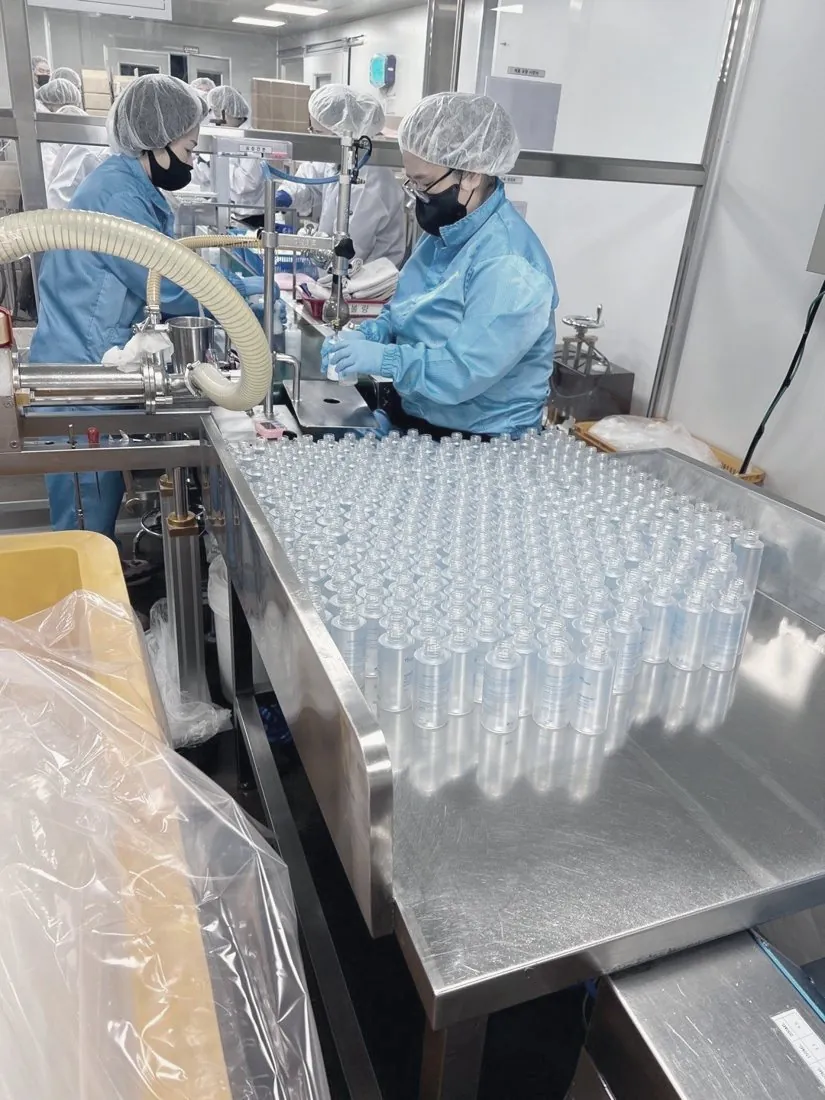
What is the difference?
BIGPIE C&T does not own a factory. Production happens at one of 34 partner manufacturers in Korea, chosen per project for its category and batch size; our team owns the brief, the samples, the packaging, the quality checkpoints, the regulatory file and the export. A direct factory is one company with its own lines, its own formula library and its own minimums, and you deal with it directly.
Read moreShow less
Neither is the right answer for every brand. The table is filled on both sides.
| Direct factory | OEM partner with a network (BIGPIE C&T) | |
|---|---|---|
| Who you deal with | The factory's sales team | Our overseas sales team; the factory is behind us |
| Unit price at volume | Often lower: no partner margin on a 50,000-unit run | Can be higher at volume, because a partner layer is paid for |
| Unit price at small volume | Often not quoted: small runs do not fit a volume line | Published from 300 units; lines chosen for small batches |
| Lead time | Can be shorter: one company, one schedule | 2 to 3 months including containers, which can be longer than a single factory's quote when the factory has the line free |
| Categories | Bound to its own lines: a mask factory makes masks, a serum factory makes serums | 34 partners across skincare, body, mask, colour, sun and sets; the line is picked per category |
| Minimums | Set by that factory's lines, for every product | 300 (ready formula), 1,000 (your own skincare formula, new or adjusted), 5,000 (cleansers, body and hair care, makeup); fixed category floors still apply (sheet masks 25,000, US sunscreen 10,000) |
| Formula library | One library | 34 libraries, plus our own 4 CERAPANO formulas |
| Quality control | The factory's own QC | Our 6 checkpoints on top of the partner's QC, and golden sample approval before the balance |
| Regulatory and export | Varies: many factories sell domestically and export through traders | EU PIF and CPSR data, MoCRA listing data, Gulf registration data, export documents with every order |
| Transparency | You know exactly who makes it | Partner names are not published; we name the line planned for your project when asked |
| Risk when something goes wrong | You deal with the factory | We deal with the factory; one contract, one contact |
| Multi-product lines | Hard if the factory does not run the category | A serum, a mask and a sun stick from three lines under one project |
When is a direct factory better?
Honestly, in three situations.
Read moreShow less
- Very high volume in one category. At 50,000 units and up of one product the partner layer is a cost with less to do. A factory that runs your category all day will quote lower, and if you have a buyer or a QC team of your own, you do not need ours.
- Speed with a free line. A factory with capacity can start when the deposit lands. Our 2 to 3 months covers container sourcing, scheduling at the partner and our checkpoints; on a simple repeat order at a factory with the line open, a direct quote can beat it.
- A formula you already own and want run as cheaply as possible. If the development is done and the product is proven, you are buying machine time, and machine time is cheapest from the machine's owner.
A fourth, which is a preference rather than a situation: some buyers want to see the line, know the owner and have no one in between. That is reasonable, and a partner model does not give it.
When is a partner network better?
Category fit. A single factory is bound to its own categories and minimums. A sheet mask line, a sunscreen line and a small-batch serum line are different machines, often in different companies. A network picks the line per category and per quantity. Our 300-unit private label orders run on a small-batch skincare line; a 25,000-unit sheet mask order runs on a mask line; neither factory would take the other's order.
Read moreShow less
Small first orders. Volume factories decline 300-unit orders or price them to discourage. Our partners for the private label route run small batches as a business, with published prices from $2.86 to $9.02 per unit across 7 tiers.
One project, several products. A 3-step routine with a toner, a serum and a cream may fit one line. Add a sun stick and a sheet mask, and it is three factories. A network manages three factories as one project, with one contract and one set of export documents.
Export and regulatory work. Many Korean factories sell mostly to Korean brands and export through trading companies. The EU data package, the MoCRA listing data and the Gulf registration file are our work on every project; we have taken our own brand through the EU notification (4 SKUs, 2026-07-20).
A second set of checks. The partner's QC checks the batch; our six checkpoints (raw material, bulk, storage and aging, filling and packing, finished goods, shipment) check the order against your brief and your golden sample.
"In our experience, the buyers who leave when we say we have no factory come back when the factory they found cannot make their second product. The ones who should stay with a factory are the ones ordering 100,000 units of one thing; we tell them so at the trade show, and sometimes introduce the line." — Minjae Lee, Head of Overseas Sales
What does the partner layer cost, and what does it do?
| What the layer costs you | What the layer does |
|---|---|
| A margin on the unit price, visible at volume | Chooses the line by category and quantity from 34 partners |
| 2 to 3 months production that a free factory line might beat | Sources containers and components; manages the partner's schedule |
| One step removed from the factory floor | Writes the brief, runs the sample rounds, approves the golden sample with you |
| Partner names not published | Six quality checkpoints on top of the partner's QC |
| Prepares the regulatory data (EU PIF and CPSR, MoCRA, Gulf) and the export documents | |
| One contract and one contact across several factories |
If you would do all of the right-hand column yourself, with your own sourcing, QC and regulatory staff in Korea, the left-hand column is pure cost and a factory is the better deal. If you would not, the layer is what you are buying.
How to tell which one you are talking to
Ask "Do you own the factory?" and listen for a yes or a no before anything else. Then:
| If they say yes | If they say no |
|---|---|
| Ask which categories the lines run, and which they do not | Ask how many partners, how the line is chosen, and who checks the order |
| Ask the minimum for your category and whether it is the line's floor | Ask the minimum per route and which category floors cannot move |
| Ask who prepares the export documents and the EU or US data | Ask for the data package list and a case with dates |
| Ask to visit | Ask whether a visit to the partner is possible once the order is confirmed |
Our answers are on the questions guide and the quality page.
Does BIGPIE C&T own a factory?
No. We work with 34 partner manufacturers in Korea and choose the line per project. Our team manages the brief, samples, packaging, six quality checkpoints, regulatory data and export.
Is it cheaper to go directly to a factory?
At high volume in one category, usually yes per unit. At small volume, and for multi-category projects, a network is often the only route that quotes at all, and the published 300-unit prices are the comparison.
Is a partner network slower than a factory?
It can be. Our production lead time is 2 to 3 months including containers; a factory with a free line and a simple repeat order can be faster. Sample lead time, about 2 weeks, is similar either way.
Can I know which factory makes my product?
We do not publish partner names, but we name the line planned for your project when you ask, and a visit can be arranged with the partner once the order is confirmed.
What happens if there is a quality problem?
You deal with us. We hold the contract with the partner, the golden sample you approved is the reference, and the six checkpoints exist to catch the problem before shipment.
Can you introduce me to a factory directly?
If your project is high volume in one category and a partner layer adds nothing, we say so. The introduction depends on the partner.
Want to know which line fits your product? Send your brief with the category and quantity, and we will say which partner line we would use and why, or whether a direct factory is the better call.
Tell us what you want to make.
Send the product, market and quantity. You get a written quote and a formula route within 24 hours.