
Guide
CPNP, CPSR and the Responsible Person: what the EU asks of a Korean-made product
Four acronyms stand between a Korean formula and a shelf in Germany. Here is what each one is, who is responsible for it, and what we learned taking our own brand through them.
What do CPNP, PIF, CPSR and RP mean?
| Term | What it is | Where in the Regulation |
|---|---|---|
| Responsible Person (RP) | A legal or natural person established in the EU who guarantees the product complies and holds the file. For an imported product, the importer is the RP unless another EU person is designated in writing. | Article 4 |
| Product Information File (PIF) | The dossier the RP keeps for 10 years after the last batch: product description, CPSR, manufacturing method and GMP statement, proof of claimed effects, animal testing data. | Article 11 |
| Cosmetic Product Safety Report (CPSR) | The safety assessment inside the PIF, in two parts: safety information (Part A) and the assessor's conclusion (Part B). Signed by a qualified safety assessor. | Article 10 and Annex I |
| CPNP notification | An entry on the Cosmetic Products Notification Portal with the product, the RP, the member state of first placing, the frame formulation and the label. Done by the RP before placing on the market. | Article 13 |
| Labelling | Name and address of the RP, country of origin for imported products, nominal content, date of minimum durability or period after opening, precautions, batch number, function, ingredient list. | Article 19 |
Read moreShow less
Two points surprise buyers. First, the CPNP notification is not an approval; nobody reviews and stamps it. The responsibility sits with the RP, and the authorities check the PIF if they inspect. Second, the PIF is never sent to Brussels. It stays with the RP, in a language the national authority can read.
Who does what?
The Regulation splits the work between the manufacturer, the safety assessor and the RP. Here is the split as it runs on our projects.
Read moreShow less
| Task | Who | Our role |
|---|---|---|
| Appoint the RP | You (your EU company, your importer, or a service provider) | We introduce a service provider; our own brand uses one in Poland |
| Supply formula data for the CPSR | Manufacturer | We supply the INCI list with percentages, raw material documents, stability and compatibility results, microbiological results, and the manufacturing method from the partner line |
| Issue the CPSR | A qualified safety assessor, commissioned by you or your RP | We send the assessor what they ask for; cost quoted at cost |
| Compile and hold the PIF | RP | We supply the pieces |
| Notify on CPNP | RP | We supply the label artwork and frame formulation data |
| Label review | Manufacturer and RP | We review against Article 19 and the member state's language; your RP gives final approval |
| Import clearance and VAT | Your importer | We prepare the export documents and the origin declaration for EU–Korea FTA preference |
The line that matters: a Korean manufacturer cannot act as your Responsible Person. The RP must be established in the EU. What we can do is make the RP's job short by handing over a complete data package.
What does the CPSR need from the manufacturer?
A safety assessor cannot write Part A from a marketing deck. The list they send, and the list we answer:
Read moreShow less
- Full formula with INCI names and percentages, by phase
- Raw material specifications and safety data (MSDS) for each ingredient
- Impurity and trace information where relevant (heavy metals, nitrosamines, 1,4-dioxane for certain ethoxylated materials)
- Stability test results and the resulting durability or period after opening
- Compatibility of formula and container
- Microbiological quality and preservative efficacy (challenge test) results
- Manufacturing method and a statement on good manufacturing practice at the partner line
- Normal and reasonably foreseeable use, exposure data
- Label and claims
Most of this comes from the partner line and the partner lab. A full ODM development produces it as part of the project; a ready formula already has it, which is one reason the 300-unit private label route is faster for the EU.
What if an ingredient is allowed in Korea but restricted in the EU?
Then the formula has to change before it can be sold in the EU. The annexes to Regulation 1223/2009 list prohibited substances (Annex II), restricted substances with maximum levels and conditions (Annex III), and the only colourants, preservatives and UV filters allowed (Annexes IV to VI). A Korean formula can be fully legal at home and still fail one of them: an ingredient may be banned, capped at a lower level, or allowed only in rinse-off products. The annexes are amended regularly; vitamin A (retinol and its esters), for example, was given concentration limits in 2024.
Check the formula against the annexes before samples are approved, not after production. We run this check with the partner line when you name the EU as your market, and the safety assessor confirms it in the CPSR.
What can the label claim?
Claims are regulated separately from safety, under the common criteria of Regulation (EU) No 655/2013. Every claim on the pack, the website or the marketplace listing must be:
Read moreShow less
| Criterion | In practice |
|---|---|
| Legally compliant | No medicinal claims ("treats acne", "heals eczema") |
| Truthful | The product does what the claim says, at the level used |
| Supported by evidence | Test results or data on file in the PIF |
| Honest | No overstating what the evidence shows |
| Fair | No disparaging competitors or legal ingredients |
| Allows an informed decision | Clear to the average consumer |
A common trap: presenting a legal requirement as a benefit. "Free from" an ingredient the EU already bans is not allowed, because every product on the market is free from it. Send us the claims you plan with the brief, and we tell you which ones the partner line has data for.
What did it look like for our own brand?
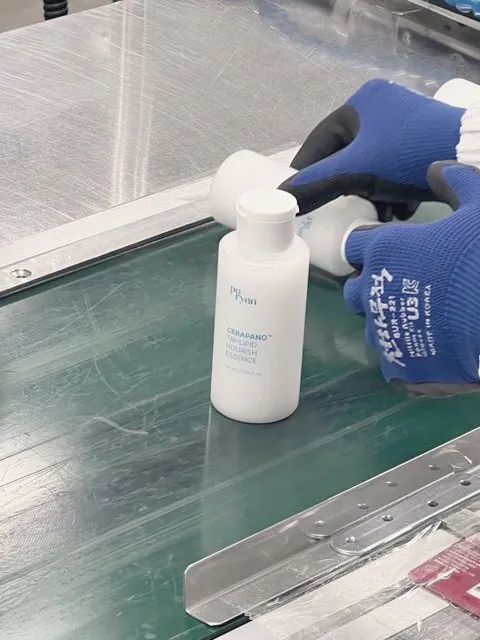
We ran PURYNN, our own 4-SKU barrier-care line, through exactly this process. The 4 products (toner, essence, ampoule, cream) were notified on CPNP on 2026-07-20 with a Responsible Person in Poland and a completed PIF and CPSR for each. The case study has the full timeline.
Read moreShow less
"In our experience, the EU notification itself takes an afternoon. The months go into collecting what the safety assessor asks for: the challenge test, the stability data, the raw material documents from each supplier. Having done it for our own four products, we now know the list before the assessor sends it." — Minjae Lee, Head of Overseas Sales
For your products on the same 4 formulas, the formula data already exists; what changes is your brand, your label and your RP, so a new CPSR and a new notification are needed under your name.
What does it cost, and who pays?
The CPSR, the RP service and the notification are services bought in the EU, and their price depends on the provider, the number of products and whether the formula is new. We do not fold them into the unit price. They are quoted at cost, as separate lines, so a 300-unit order is not inflated by a fixed cost that would look the same on a 30,000-unit order.
Read moreShow less
| Line | Who invoices | In our unit price? |
|---|---|---|
| Safety assessor (CPSR) | Assessor or RP service, passed through at cost | No |
| Responsible Person service, annual | RP service | No |
| CPNP notification | Usually part of the RP service | No |
| Formula and safety data package | BIGPIE C&T | Yes, as part of the project |
| Label review | BIGPIE C&T | Yes |
What about duties into the EU?
Most cosmetics under HS heading 3304 enter the EU duty-free under the EU–Korea Free Trade Agreement when the shipment carries an origin declaration. VAT is charged at the national rate of the member state of import. We prepare the certificate of origin and the origin declaration with the export documents.
Checklist for an EU launch
A Responsible Person (RP) established in the EU holds a Product Information File (PIF) with a Cosmetic Product Safety Report (CPSR) and notifies each product on the CPNP portal before it is placed on the market. A Korean manufacturer cannot be your RP.
- You / importer
- BIGPIE C&T
- You / importer
- You / importer
- BIGPIE C&T
- BIGPIE C&T
- You / importer
Duty and tax: Most cosmetics (HS 3304) enter duty-free under the EU–Korea FTA with an origin declaration; VAT applies at the national rate.
Sources: Regulation (EC) No 1223/2009 on cosmetic products, EUR-Lex · Cosmetic Products Notification Portal, European Commission · EU–Korea Free Trade Agreement, European Commission
Can BIGPIE C&T be my Responsible Person?
No. The RP must be established in the EU. We supply the data and introduce a service provider; our own brand uses one in Poland.
Is CPNP an approval or a certificate?
Neither. It is a notification. There is no approval step and no certificate; the RP receives a reference number for the product. Compliance is checked by national authorities through the PIF.
Do I need a new CPSR if I use your ready formula?
Yes, under your brand name and with your label, even though the formula data already exists. The existing data makes it faster and usually cheaper.
Does the UK accept the EU notification?
No. Great Britain has its own system since 2021: a UK Responsible Person and a notification on SCPN. The EU files are a good base, but the notification is separate.
How long does EU registration take?
It depends on the assessor's and the RP's workload and on how complete the data is. Start it when the formula is locked so it runs alongside the 2 to 3 month production.
Do I need a separate CPNP notification for every product?
Yes, per product. Shades of one product can be handled within a single notification in the ways the portal allows, but each distinct product, such as a toner and a cream, is notified separately.
Which language must the label be in?
The language required by the member state where the product is sold, for the mandatory information in Article 19. The ingredient list uses INCI names.
Sources
- Regulation (EC) No 1223/2009 on cosmetic products, Articles 4, 10, 11, 13 and 19, EUR-Lex
- Regulation (EU) No 655/2013, common criteria for cosmetic claims, EUR-Lex
- Cosmetic Products Notification Portal (CPNP), European Commission
- EU–Korea Free Trade Agreement, European Commission
- Make cosmetic products available in Great Britain, GOV.UK
Planning an EU launch? Send your brief with the member state of first sale, and we will list the data package and the registration lines before you order samples.
Tell us what you want to make.
Send the product, market and quantity. You get a written quote and a formula route within 24 hours.